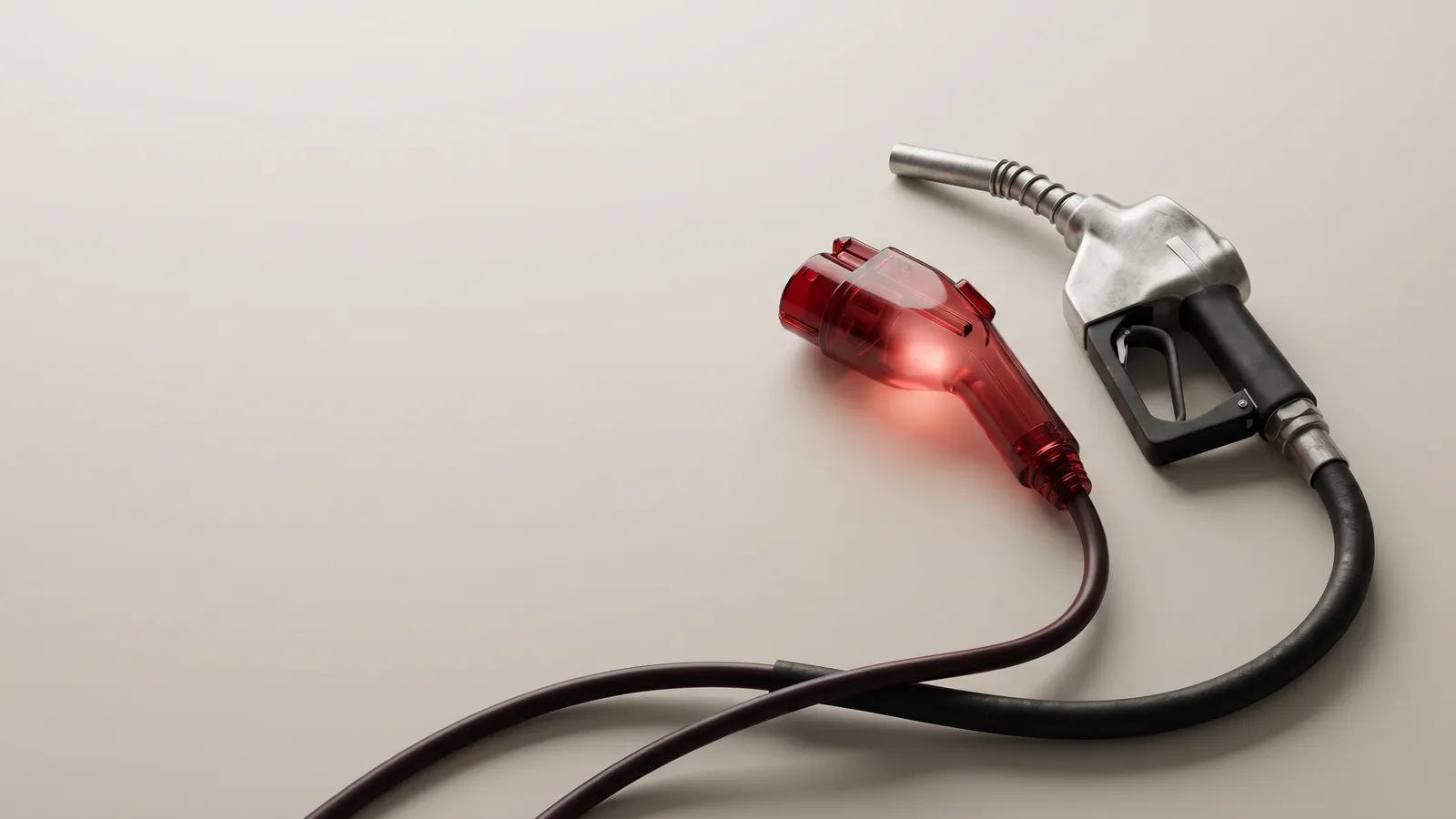

More and more companies add hybrids to their fleets. In 2024, Uzbekistan imported 80,235 passenger cars, and 39,564 of them were electric cars and hybrids.
Accounting is left without rules. There are no state consumption norms for hybrids. Companies order norms from private laboratories and get two at once: one for petrol and one for electricity.
Then the questions start. How to write off petrol and electricity. How to tell that consumption is not inflated. What to tell the tax authority if there is a deviation.
This article is based on a real Advizen project for a company with a hybrid fleet. Client data is anonymised, and the figures in the examples are illustrative.
Three types of hybrids
- HEV, a regular hybrid. No plug. The battery charges from the engine and when braking. For accounting purposes, it is an ordinary petrol car.
- PHEV, a plug-in hybrid. It has a plug. The wheels are driven by the electric motor, the petrol engine or both. Example: BYD models with DM-i technology.
- EREV, an extended-range hybrid. Only the electric motor drives the wheels. The petrol engine works as a generator and charges the battery. Example: Li Auto.
The rest of this article is about PHEV and EREV. These are the cars with two energy sources and two norms.
The main mistake: two norms over the full mileage
A laboratory measures each norm separately. The petrol norm while driving on petrol only. The electricity norm while driving on the battery only.
If both norms are applied to the full mileage, the norm doubles. The car physically cannot use that much energy.
How the norm doubles
Hybrid, 2,000 km in the city
- Petrol at the norm for the full mileage2,000 km × 7.3 l / 100 km
- 146 l
- Electricity at the norm for the full mileage2,000 km × 20.0 kWh / 100 km
- 400 kWh
- This energy would cover
- 4,000 km
Each of the two amounts would cover the whole trip on its own. Together they are enough for 4,000 km, while the car drove 2,000.
Why mileage cannot be split into petrol and electric
The second common idea is to split the kilometres into “petrol” and “electric” ones and apply its own norm to each part. It does not work.
Energy reaches the battery from three places. From a charging station, which comes with an invoice. From the petrol engine and from braking, which come with no documents.
Inside the battery the energy mixes. The on-board statistics for “petrol” and “electric” mileage are calculated differently by different models and are not a primary document.
There is also double counting. The energy the engine gave to the battery is already counted through the petrol. Counting it again as electricity inflates the consumption.
A simple method: the sufficiency check
We suggest a different approach. Write off actual consumption based on documents, and use the norms only for control.
The control question is simple. Do the petrol filled and the electricity received cover the distance the car drove. And are they not more than needed.
Work out how many kilometres the energy covers
Petrol for the period × 100 / petrol norm. Electricity for the period × 100 / electricity norm.
The sum of the two is the calculated mileage.
Compare it with the odometer
Deviation = calculated mileage − actual mileage. Divide it by the actual mileage to get a percentage.
Example check
Hybrid, one month, 2,000 km
- Petrol70 l × 100 / 7.3 l
- 959 km
- Electricity210 kWh × 100 / 20.0 kWh
- 1,050 km
- Calculated mileage
- 2,009 km
- Odometer mileage
- 2,000 km
- Deviation
- +0.4%
The deviation is 0.4%. That is within tolerance. The energy matches the mileage, and the write-off is justified.
How to read the deviation
| Result | What it means | What to do |
|---|---|---|
| Within ±5% | The energy matches the mileage | Write off the actual amount |
| Above +5% | More energy was used than needed. Possible overconsumption | Find the cause and draw up a report |
| Below −5% | Not enough energy for the mileage. A fill-up or a charge is missing from the records | Find the missing documents |
| Consumption without mileage | The car did not move, but fuel was written off | Investigate at once |
We suggest 5% as a guide. The company sets the exact value itself.
If the car was never charged, the formula still works. The second term is zero, and the check runs on petrol only.
Use the city norm. Out-of-town trips serve as an explanation when the deviation is large.
Check your car
Enter the data for a month or a quarter. The calculator works out the calculated mileage and shows what to do with the deviation.
Sufficiency check
The fields hold the example from this article. Replace the figures with your own.
- Petrol covers
- 959km
- Electricity covers
- 1 050km
- Calculated mileage
- 2 009km
- Odometer mileage
- 2 000km
Within toleranceDeviation +0.4%
The energy matches the mileage. The consumption can be written off as it is.
The calculation runs in your browser. No data is sent anywhere.
Winter, summer and the last-day fill-up
In winter the heater runs, in summer the air conditioning. Consumption rises for every car at once. You do not need seasonal coefficients for that.
Compare the car's deviation with the average deviation of the rest of the fleet for the same month. If the gap is no more than 5 percentage points, it is the season. If it is larger, it is a reason to look closer.
If the average for the whole fleet is outside tolerance, the problem is most likely the norms. They should be reviewed.
Calculate every month, and draw conclusions at the end of each quarter on a year-to-date basis. This removes the problem of a fill-up on the last day of the month. The shift evens out in the next period.
Accounting
- Petrol. Written off by fill-ups for the period, based on fuel card reports and filling station receipts. The fuel left in the tank is not counted, because it cannot be measured reliably.
- Electricity. Recognised as an expense in the month of charging and not carried as inventory. The charge in the battery cannot be counted in a stocktake. In the project, an attempt to keep electricity in stock produced a negative balance.
- Late invoice. If the charging invoice arrives later, the expense still belongs to the month of charging. The invoice serves as confirmation.
The basis for this is the Law on Accounting. Expenses are recorded in the period they relate to. Checking consumption against norms is internal control, not a basis for accounting entries.
Taxes: what it takes for the expense to be accepted
Corporate income tax. An expense is deductible if it is justified and supported by documents (Tax Code, Art. 305). Exceeding a control norm does not by itself prohibit the deduction. It has to be explained in a report or an internal memo.
VAT. Input VAT on passenger cars and their fuel cannot be offset if they are not related to the company's activity (Tax Code, Art. 267). The State Tax Committee treats electric cars as passenger cars and the electricity for them as fuel. An offset requires a VAT invoice with VAT shown separately (Tax Code, Art. 266).
One word in the accounting policy that can cost the deduction
The Tax Code has rules on losses above natural loss norms. If the state has not set such norms, the company sets them itself.
So the company's document should say plainly that the consumption norms are control indicators, not natural loss norms. Then a deviation is examined on its merits rather than disallowed automatically.
According to the State Tax Committee, an audit looks at waybills with routes and mileage, fuel write-off reports, insurance policies, fines and accidents. If the drivers are not company employees or the cars are not used for business, the VAT offset will be removed.
There is currently no mandatory state waybill form for company passenger cars. Electronic waybills under Cabinet of Ministers Resolution No. 44 were piloted in 2024, and we found no extension of the pilot. The company approves its own waybill form.
Corporate income tax is reported quarterly (Tax Code, Art. 338), VAT monthly. If unjustified overconsumption is found at the end of a quarter, a corrected VAT return for the specific month may be needed.
A large deviation? Check the data first
In the real project, the average fleet deviation first came out at about +45%. Almost all of it turned out to be data errors, not overconsumption.
What to check when the deviation is large
7 items
- The mileage matches the waybills
- All fill-ups and charges belong to this carA common mistake: one car's fill-up is booked to another
- No typos when copying from filling and charging station reportsIn the project, 30 l turned into 300 l because of an extra digit
- The car's version is recorded correctlyNorms differ between versions of one model with different range. The error is about 7%
- The period's mileage is not too lowWith a few hundred kilometres, one missing fill-up gives tens of percent
- Out-of-town trips and long idling with climate control on are taken into account
- The cause is recorded in a report or an internal memo
If the overconsumption is still unexplained, the unjustified part is split into litres and kilowatt-hours in proportion to their shares of the calculated mileage. It is valued at cost and recorded in a commission report.
How neighbouring countries handle it
| Country | How the question is solved |
|---|---|
| Russia | In 2021, kWh consumption for 46 models was added to the Ministry of Transport norms. All of them are fully electric cars, with no hybrids among them |
| Belarus | Electricity norms for electric cars have not applied since 2022. Electricity is written off straight to expenses |
| Uzbekistan | There are no state norms for hybrids. The company sets its own write-off procedure |
Nobody has a ready-made solution for hybrids. None of these countries officially splits mileage by energy source. The company writes its own procedure for hybrids, and its quality decides whether the tax authority accepts the expense.
What to put in the accounting policy
Everything described above works only once it is written into the company's document. An audit looks not at the formula in the accountant's spreadsheet but at the approved procedure.
In its 2024 clarification, the State Tax Committee says directly that for a car running on two types of fuel, the company should develop a procedure and write-off norms for each type and fix them in the accounting policy.
- Consumption norms as control indicators, not natural loss norms
- The sufficiency check formula and the tolerance
- Comparison with the fleet average instead of seasonal coefficients
- Monthly calculation and a quarterly year-to-date conclusion
- Petrol written off by fill-ups, electricity in the month of charging
- Waybill form and a log of charging sessions for each car
- Charging only at recorded sources
- Overconsumption report form and how it is valued
Sources
- Tax Code of the Republic of UzbekistanArt. 266, 267, 269, 305, 317, 338lex.uz ↗
- Law on Accounting No. ZRU-40413.04.2016lex.uz ↗
- National Accounting Standard No. 4 “Inventories”lex.uz ↗
- Cabinet of Ministers Resolution No. 44 on electronic waybills22.01.2024lex.uz ↗
- State Tax Committee on VAT offset for electric cars, electricity and fuelbuxgalter.uz, 15.07.2024, in Russianbuxgalter.uz ↗
- Electric and hybrid vehicle imports overtake conventional cars for the first timeTashkent Timestashkenttimes.uz ↗